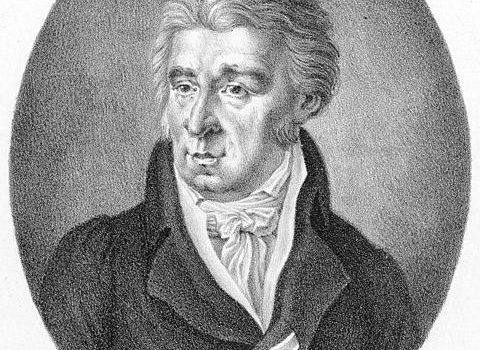
Peter von Winter
Category : composers | Kp en
Peter von Winter (until 1814 Peter Winter; baptized August 28, 1754 in Mannheim; died October 17, 1825 in Munich) was a German composer, singing teacher, and Kapellmeister.
Peter Winter was the son of a brigadier at the Electoral Court in Mannheim. At the age of ten, he was already playing violin in the Mannheim Court Orchestra and is documented as a double bassist in 1773. From 1776 onward, he was permanently engaged as a violinist with the title of “Hofmusicus.” At the same time, he became the leader of Theobald Marchand’s private singing troupe, which performed German Singspiele.
In Mannheim, Winter, like Franz Danzi (and later Carl Maria von Weber and Giacomo Meyerbeer), was a student of Abbé Vogler. When the Mannheim Court Orchestra followed Elector Karl Theodor to his new residence in Munich in 1778, Winter also moved there (along with Danzi, Cannabich, and others). In the same year, he married the tailor’s daughter Marianne Grosser. From Munich, he undertook numerous concert tours. With an electoral scholarship, he was allowed to travel to Vienna in 1780/81 with his orchestra colleague Franz Tausch to take lessons from Antonio Salieri. In 1787, he became vice-court conductor for vocal music in Munich, and in 1798, court conductor. In 1811, he founded the Musical Academy, which continues to this day in the Academy concerts of the Bavarian State Orchestra. Christian Friedrich Daniel Schubart, in his “Ideas on the Aesthetics of a Musical Art,” emphasizes Winter’s symphonies and their treatment of minor-key episodes.
His main work is the singspiel Das verhinderte Opferfest (The Interrupted Sacrifice Festival), premiered in Vienna in 1796 and enjoyed enormous success throughout Europe well into the mid-19th century. It was probably last performed in 1917, during an opera festival week in Leipzig. The work’s popularity is also evident in the composition of seven variations on Beethoven’s “Kind, wollen du ruhig schlafen” (WoO 75). Like Goethe, Winter attempted a sequel to Mozart’s The Magic Flute with the “great heroic-comic opera” Das Labyrinth oder der Kampf mit den Elemente (1798), based on a text by Schikaneder. Winter also composed one of the musical settings of Goethe’s singspiel Scherz, List und Rache (Scherz, List and Rache).
In the course of extensive travels, Winter presented his stage works throughout Europe. In addition to his numerous stage works, he also created chamber and orchestral compositions, including some symphonies and solo concertos, always in three movements. In 1808, he became a member of the Paris Conservatory, and in 1815, of the Royal Swedish Academy of Music. On March 23, 1814, King Max Joseph of Bavaria awarded him the Order of Merit of the Bavarian Crown to mark his fiftieth anniversary as a court musician, thereby raising him to the personal nobility. As a music educator, the now-named Peter von Winter earned merit through the publication of his “Complete Singing School” in 1825. After his death, the Allgemeine Musikalische Zeitung in Leipzig dedicated a long, fourteen-page article to him, expressing his assessment at the time as one of the most important German composers of his time. In the Magic 5, Peter von Winter composed the entire opera The Labyrinth and the second act of “The Pyramids of Babylon.”


